Why sovereignty matters now.
Europe is waking up to a simple fact: if your website depends on foreign infrastructure and services, your business depends on foreign rules.
What “EU digital sovereignty” means (in plain language)
It’s the ability to operate, to comply, and to keep choosing—without your stack being silently governed by someone else.
It’s about reality, not labels
A company can be “European” and still run on a supply chain made of non‑EU bricks: DNS, CDN, analytics, payments, identity, email. Sovereignty asks: what happens if any of those bricks change rules, pricing, or access?
It’s about jurisdiction
The country on your invoice isn’t the whole story. Ownership, legal reach, and data processing paths matter. If a critical vendor can be compelled by extraterritorial law, that exposure is part of your risk.
It’s about continuity
The “wind is turning”: procurement requirements, public-sector expectations, and regulated buyers increasingly demand proof. Sovereignty becomes an operational requirement, not a political opinion.
The turning point (and why teams feel it)
What used to be “nice to have” is becoming “you need an answer” — for buyers, auditors, and your own resilience.
Pressure is moving upstream
Customers don’t ask “which framework do you use?” They ask: where is data processed, who can access it, what happens under a legal request, and how fast you can change vendor if needed.
Complexity became invisible debt
Teams inherit stacks. Over time, “small” third‑party scripts become core dependencies. When you discover them during an audit or an incident, it’s already late.
EU-first is becoming a strategy
Not because the world is binary—but because exit options matter. EU-first doesn’t mean isolation; it means the ability to choose and to prove.
Regulations, filtered for stacks
Focus on implications, not law text.
GDPR ≠ sovereignty
Compliance on paper doesn’t guarantee jurisdictional control.
Schrems II → transfers
Cross-border flows require real safeguards—not checkbox clauses.
NIS2 → critical services
Operational resilience and supplier exposure are now audited.
DSA/DMA → platforms
Platform dependencies raise conduct, access, and fairness risks.
How StackAudit makes it concrete
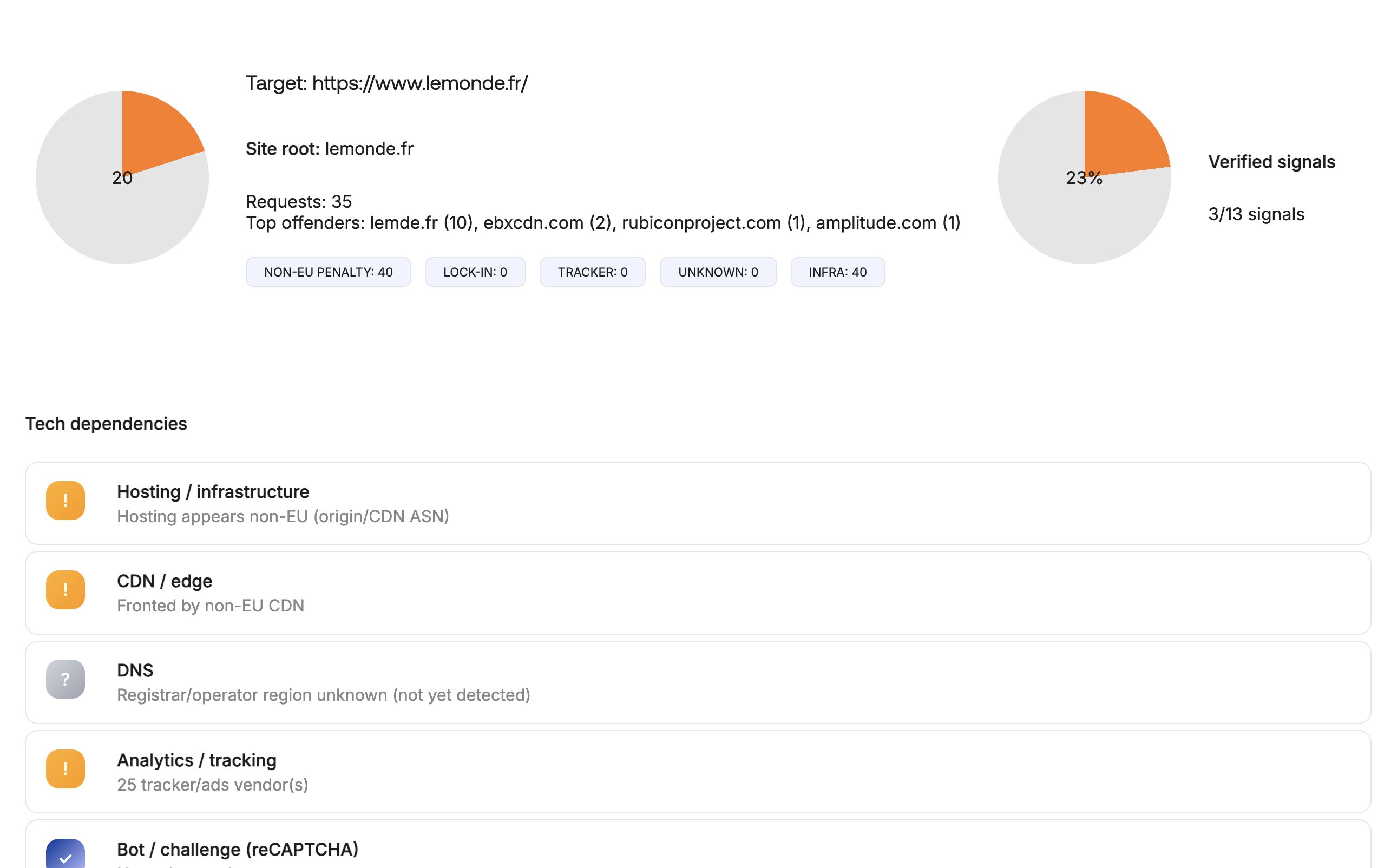
A practical audit: map dependencies, attribute vendors, then propose an EU-first path.
Dependency map
We observe requests and HTML signals to catalog the services your site relies on.
Infra signals
DNS and ASN enrichment help flag infrastructure exposure and hidden routing dependencies.
Risk framing
We translate signals into decision language: jurisdiction, lock‑in, and operational criticality.
Action plan
Clear recommendations and EU-based alternatives to move, step by step.
EU-Native Label
Turn insight into value.
What the label means
Proof that your stack meets EU-first criteria across infra and vendors.
What it certifies
Verified sourcing, jurisdictional control, and reduced lock-in.
Label levels
EU-Aware → EU-Ready → EU-Native to match your maturity.
Where to display it
Procurement packs, trust centers, and marketing for regulated buyers.
What you get
A clear score
See your sovereignty posture at a glance.
Actionable recommendations
Concrete swaps and mitigations you can ship.
A defensible position
Evidence you can share with auditors, buyers, and counsel.
Optional public label
Show EU-first credentials when you’re ready.
Know your dependencies.
Build an EU-first stack.
You don’t need a manifesto. You need clarity, a baseline, and a path you can execute.